
About this report
Disability Rights North Carolina (DRNC) is North Carolina’s Protection and Advocacy (P&A) organization, charged with advocating for people with disabilities. By federal law, DRNC is empowered to monitor any setting where people with disabilities live or receive services to ensure their rights are protected and, where necessary, investigate and take action to end and prevent abuse or neglect of disabled people.
In late 2024, DRNC conducted a monitoring visit at the Madison County Juvenile Detention Center (MCJDC), a county-operated juvenile detention center (JDC) run by the Madison County Sheriff’s Office under contract with the state Division of Juvenile Justice and Delinquency Prevention (DJJDP). Youth confined to JDCs in NC are either awaiting resolution of their cases in juvenile or adult court, or placement in another facility or program. Twenty-one youths were being held at the MCJDC when DRNC monitored. DRNC spoke with the majority of the youths in the facility. The horrific conditions shared by the young people and the facility’s subsequent closure are the subject of this report.
DRNC’s monitoring visit to Madison County JDC was part of a year-long effort to monitor in every JDC in the state. DRNC undertook this effort based on concerning reports about conditions in certain JDCs. A full report of our findings statewide, “Behind Locked Doors: Inside North Carolina’s Juvenile Detention Centers,” details the results of that effort.
Findings
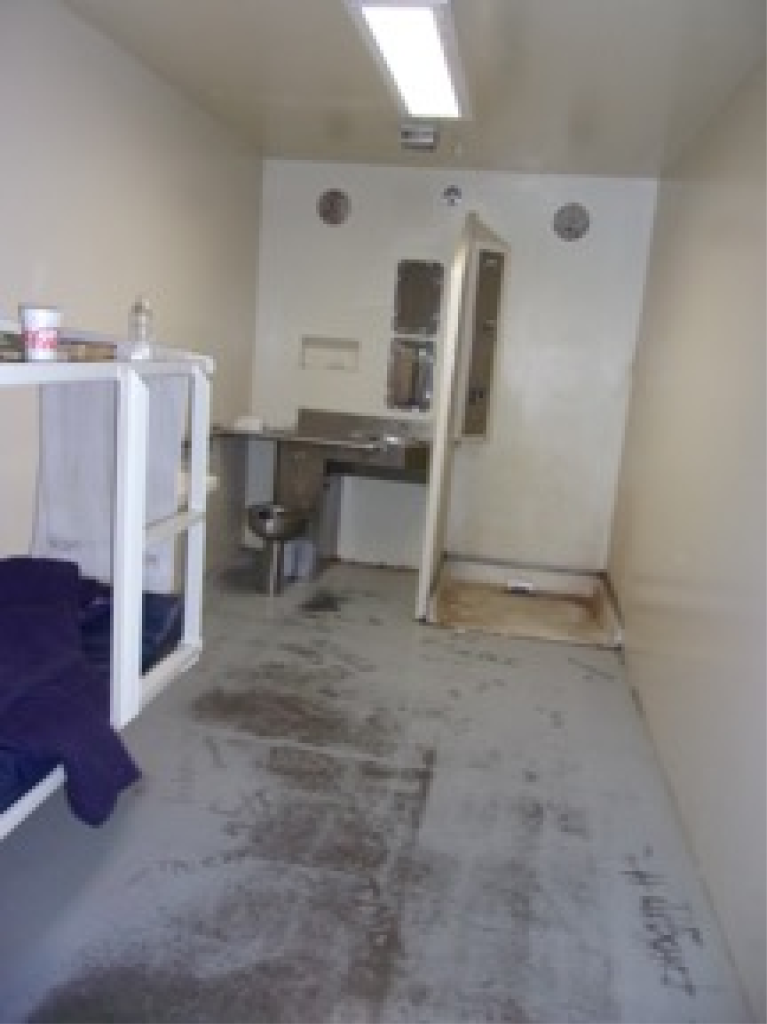
Physical Environment – MCJDC occupied two pods of the adult jail in Madison County. The physical environment felt like an adult correctional setting, with heavy sliding locking doors to cells. Youths’ cells had no window to the outside, only a narrow window to the cell block.
Abusive Discipline – The main forms of discipline in the MCJDC were pepper spraying, using tasers, and putting youth in “lockdown” or solitary confinement-like conditions.
Pepper Spraying and Tasing – Multiple youth had been pepper sprayed, including for minor violations or for no given reason. DRNC heard repeated reports of youth being tased in the facility.
Lockdown – Multiple youth reported being placed in solitary confinement as discipline. For minor violations, such as perceived disrespect, lockdown could mean several days – often three – locked in a cell. For major violations, such as a fight, lockdown could mean 30 days of solitary confinement, or isolation in a cell with one cellmate. Back-to-back stints in solitary confinement were not uncommon, with youth reporting up to 120 days – four months – of lockdown. Use of positive, trauma-informed, skill-building responses to youth behavior – promoting safety and rehabilitation for youth – is the far better alternative to cell confinement as discipline.
Youth on lockdown at MCJDC did not go to school, have recreation time, or get phone calls, not even to their lawyers. They typically only came out of their cells to get their meal trays.
This use of solitary confinement is in grave violation of best practices and DJJDP policy. The North Carolina state prison system banned the use of solitary confinement for youth under 18 in 2016. Other states ban the use of solitary confinement as punishment or otherwise restrict its use, such as limiting the length or conditions of solitary confinement.
DJJDP policies state that cell confinement as discipline should only be used after all less restrictive measures have been exhausted or determined ineffective (DJJDP Policy DC 1-3 2.3.3(5)). DJJDP policies also state that cell confinement in response to behavior should be limited to the amount of time needed for the youth to regain control and return to the general population (DJJDP Policy DC 1-3 2.3.8(2)). County contracted JDCs are required to follow DJJDP policies concerning confinement of youth.
Solitary confinement has been defined as keeping an incarcerated person locked in their cell for more than 22 hours a day. The harmful psychological and physical impacts of solitary confinement have been well documented. These can range from insomnia, hypertension, and paranoia to PTSD, depression, psychosis, suicidal ideation, and premature death. The risks of solitary confinement are greater for youth. Young people and people with mental health disabilities should not be subjected to solitary confinement. Multiple youth at MCJDC had experienced the negative mental health impacts of being on lockdown. Youth generally reported having no access to a counselor or therapist in general or while on lockdown.
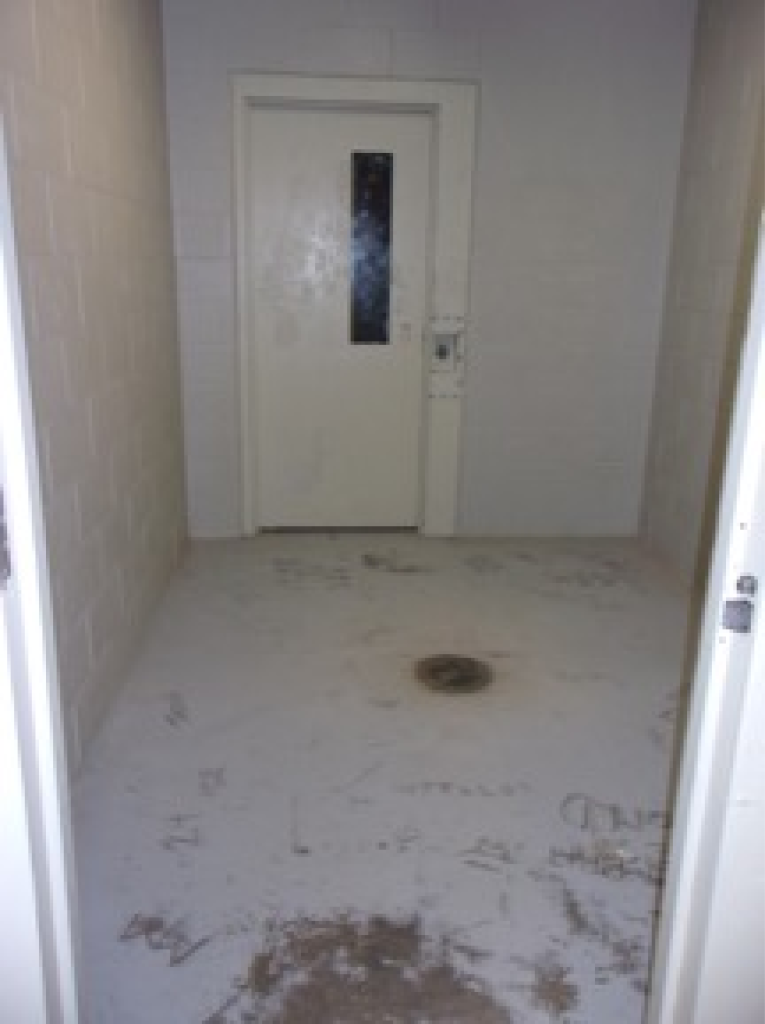
The “Detox Cell” – Youth also could be and had been taken to the jail’s “detox cell” as discipline. The detox cell was a bare cell, with only a hole in the floor for urination or defecation. It was severe: odorous, cold, barren, and reportedly outside the view of cameras. The detox cell had no windows to the outside, no bed, and nothing to sit on. Youth placed in the detox cell were only given a mat to sleep on from 9 PM to 6 AM with no cover, and otherwise had to stand, sit, or lay on the hard floor. The detox cell did not have a shower.
Youth reported that kids could be taken to the detox cell for punishment for as long as a week or more. They also reported staff would take youth to the detox cell to pepper spray them because it was outside the view of cameras.
Physical Assaults and Verbal Threats – Other instances of abuse and violence at the hands of facility staff were reported, including multiple instances of physical assault of young people by staff, and staff threatening youth.
While some young people noted that some staff treated them decently or positively, overall, the reported abuse and neglect was so egregious that DRNC staff were compelled to immediately alert authorities.
Lack of Education – In addition to these conditions, youth were denied educational services in violation of state and federal law and DJJDP policy (NCGS 115C-1, NCGS 115C-81.5, 20 USC 1400 et seq, DJJDP Policy FO 8.2 – 3). Madison County Schools provided educational services in the MCJDC, but educational services were minimal at best. Youth reported that there was no opportunity to earn high school credits from the limited instruction provided. Instead, the young people were only allowed to study for high school equivalency tests but were given no opportunities to actually take the tests. Youth reported that school largely consisted of self-studying from GED books. No Exceptional Children’s (special education) services were reported to be available for students with special education needs. These conditions resulted in youth being denied statutorily-required education for their entire stay in the MCJDC, up to many months and for some youth, for more than a year.
Outcome
Given the horrific and ongoing abusive conditions youth reported to DRNC staff, DRNC alerted state authorities about the allegations of abuse and neglect.
State child welfare officials worked to assign an appropriate local child welfare agency to conduct an investigation. With the collaboration of the NC Department of Public Safety Division of Juvenile Justice and Delinquency Prevention and within hours of beginning their on-site investigation, child welfare officials worked to remove all youth from the MCJDC. This interagency collaboration was significant because it allowed officials to remove the young people from the facility without delay.
After a comprehensive investigation by the assigned child welfare agency, the investigators substantiated the allegations of abuse and neglect at the facility. DJJDP no longer places youth at the MCJDC.
How are the youth now?
After the state moved all the youth who were at the MCJDC to other facilities in the state, DRNC staff traveled and were able to meet with 20 of the 21 relocated youth. DRNC staff confirmed that they were in environments free from the egregiously abusive conditions they previously endured. DRNC commends the state’s quick response to the disturbing allegations.
Recommendations
In substantiating the abusive conditions at the MCJDC, the assigned child welfare agency made the following recommendations:
- No youth should be placed at the MCJDC in the future, unless there is a significant overhaul of staff training and oversight.
- Tasing, pepper spray, and isolation tactics should not be used in any juvenile detention facility.
- The NC Division of Health Services Regulation (DHSR), or another appropriate State agency, should monitor all juvenile detention facilities to ensure appropriate mental health service provision for youth.
- The NC General Assembly must require juvenile detention facilities, when hiring staff, to check the registry [Responsible Individuals List (RIL)] of those individuals responsible for child abuse or serious neglect.
In addition, DRNC makes the following recommendations:
- DJJDP develops and implements a robust, quarterly in-person monitoring plan to provide oversight of county-operated JDCs, to include speaking with youth about conditions there, to ensure an environment that is free from abuse and neglect and provides appropriate mental health and educational services for youth.
- DJJDP, in accordance with state and federal law and DJJDP policy, ensures that a traditional high school diploma pathway is available to all youth who desire it.


